

My living room sofa used to feel like a trap. When I first transitioned to remote work, I spent eighteen months waking up with a knotted stomach, checking Slack from my pillow at 6:45 AM, and feeling a dull, persistent dread humming beneath my ribcage. Without a commute to mark the end of the day, my home stopped feeling like a sanctuary. It became an office where I happened to sleep.
Learning how to manage work anxiety working from home requires more than drinking herbal tea or lighting a candle. It demands a systematic re-engineering of your physical surroundings, your nervous system’s daily rhythms, and the stories you tell yourself about your productivity.
The Biological Reason Remote Work Heightens Stress

Working outside a traditional office removes external friction, but it strips away natural sensory transitions. When your bed sits twenty feet away from your computer, your brain never receives the environmental trigger that confirms you are safe to unwind.
According to research published by the American Psychological Association (APA), blurred boundaries between domestic and professional environments directly heighten baseline cortisol levels. When every room carries work associations, the sympathetic nervous system stays perpetually activated in low-grade fight-or-flight mode.
Breaking the Hyper-Responsiveness Trap
My deepest anxiety source came from what I call “presence paranoia”—the frantic urge to answer every ping within twenty seconds so teammates knew I was working.
This hyper-responsiveness fragments your attention and spikes adrenaline throughout the day. Remote leaders respect deliberate focus far more than frantic availability. As highlighted in discussions by the Harvard Business Review, asynchronous communication is the bedrock of sustainable remote organizations. When you establish explicit status updates and set predictable response windows, you dismantle the invisible pressure to hover over your inbox.
Reclaiming Physical Space From Cognitive Intrusion
If you work from your sofa or bed, you train your brain to associate places of recovery with performance pressure.
I live in an apartment where a separate library or corner office is out of the question. I solved this by choosing one small wooden desk by the window. That desk exists only for work tasks. When my laptop is open there, I am clocked in. The moment I shut the screen and step onto the carpet, work ceases to exist in that room. Treat your resting zones as sacred ground.
Real-Time Strategies to Neutralize Daily Work Strain

When work panic strikes in the middle of a sprint, abstract advice does not help. You need physiological levers that directly intercept physical anxiety signals.
Downregulating Your Nervous System on the Clock
You cannot talk a racing heart into slowing down using logic alone. You must engage the vagus nerve directly through respiration.
Whenever an urgent message makes my chest tighten, I immediately push back from the desk and practice box breathing. The Cleveland Clinic highlights box breathing as one of the most reliable methods to activate parasympathetic recovery:
- Inhale through the nose for four seconds.
- Hold your breath for four seconds.
- Exhale slowly through the mouth for four seconds.
- Hold empty for four seconds.
Three consecutive rounds reset your heart rate variability. It physically stops the panic feedback loop before you draft a panicked reply.
The Artificial Commute Ritual
Losing your daily drive or train ride feels convenient until you realize that commuting served as an indispensable decompression chamber. Commuting gave your psyche permission to transition roles.
I replaced my former commute with a non-negotiable ten-minute morning walk around my neighborhood. I do not listen to work podcasts or check emails during this time. I look at trees, feel the morning temperature, and allow my thoughts to wander.
In the evening, I repeat the exact same route in reverse. That physical movement tricks my mind into acknowledging that the professional persona is turning off and the personal self is taking over.
Cognitive Restructuring for Remote Professionals

Physical boundaries collapse quickly if your internal expectations remain toxic. Managing remote stress requires an intentional mindset shift regarding what work actually means.
Disconnecting Identity from Instant Messaging
Early on, every critical email felt like a verdict on my character. I tied my emotional security directly to project updates and manager tone.
The most liberating breakthrough occurred when I learned to separate self worth from career success. A delayed deadline or a difficult client call does not diminish your dignity as a human being. Your career is an agreement to deliver focused value during contracted hours—not an ownership deed to your emotional peace.
To reinforce this, construct explicit and healthy workplace boundaries. When teammates schedule meetings during your focus blocks or send messages past six in the evening, decline them calmly. Clear boundaries demonstrate professional maturity, not defiance.
The Evening Shutdown Protocol
Work anxiety thrives on unfinished loops. If you leave loose tasks scattered across open browser tabs, your subconscious ruminates on them all evening.
Every afternoon at 5:00 PM, I execute a structured shutdown routine:
- Conduct an open-tab sweep: Bookmark or close every working tab so tomorrow begins with an empty canvas.
- Draft the tomorrow list: Write down the three primary milestones for the next business day on paper.
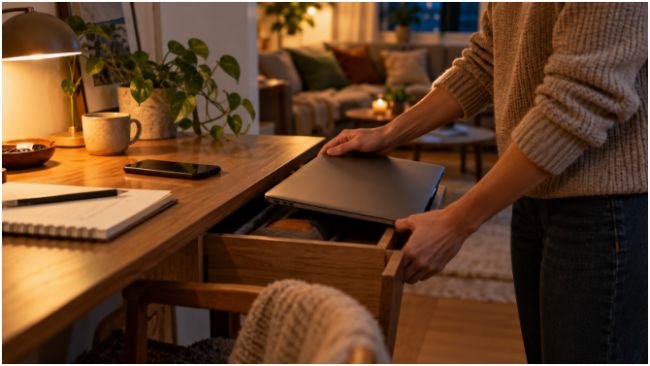
- Run the physical disconnect: Close the laptop, cover it with a neutral cloth or slip it into a drawer, and switch your phone to work-focus mode.
This closing routine signals the end of the workday to your nervous system.
Stop Living at the Office: Take Your Evenings Back
Working from home should grant you autonomy, not an inescapable cubicle inside your living room. The persistent worry that you should always be producing something is an illusion born of bad remote culture, not your personal inadequacy.
Reclaim your domestic space today. Pick one small physical boundary to enforce tonight: walk around the block at five o’clock, shut your laptop lid, and do not peek at your inbox until morning. You do not owe your company your peace of mind.
Frequently Asked Questions
1. Why does working from home cause so much anxiety?
It erases natural physical boundaries between professional pressure and domestic sanctuary, leading to chronic overwork and sensory isolation.
2. How do I stop thinking about work after logging off at home?
Implement a tactile shutdown ritual: pack your work gear completely out of sight and take a ten-minute walk to mark the end of the shift.
3. What should I do during an acute anxiety spike during remote work?
Step away from your workstation immediately and run three cycles of four-second box breathing to engage your parasympathetic nervous system.
4. How do I talk to my manager about remote work burnout?
Frame the discussion around performance sustainability by requesting clear priority alignments and scheduled focus periods during standard business hours.