
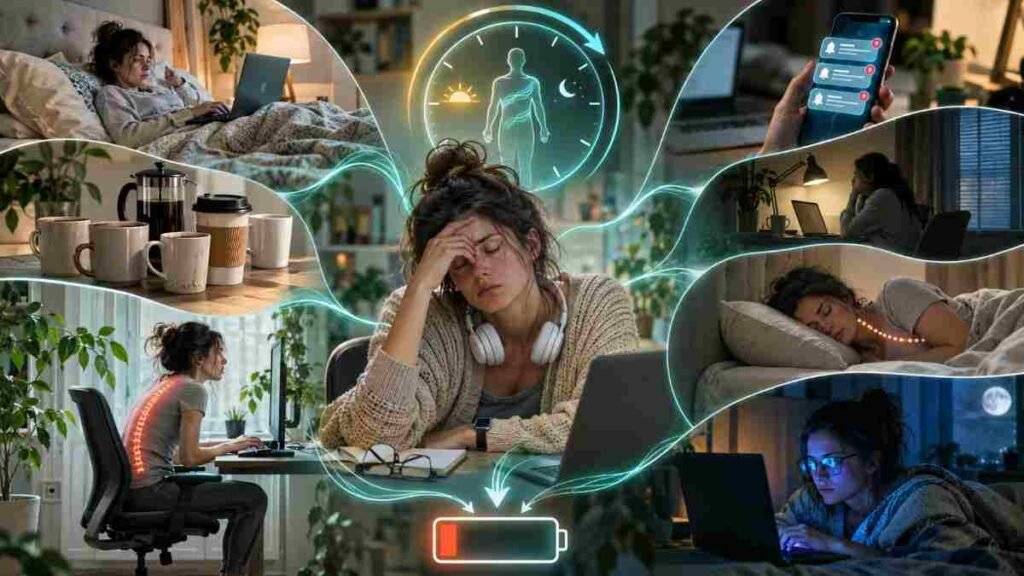
Remote work was supposed to be the ultimate cure for burnout. Eliminating grueling commutes, packed transit, and rigid office dress codes promised extra personal time, lower stress, and boundless daily energy.
Yet millions of remote professionals confront a perplexing reality: persistent, bone-deep exhaustion. You haven’t navigated rush-hour gridlock or spent hours running across a corporate campus, so why does closing your laptop at 5:00 PM feel like crossing a marathon finish line?
The answer lies in subtle behavioral shifts that govern home environments. Without the physical boundaries of a traditional workplace, everyday habits quietly drain cognitive stamina, disrupt sleep architecture, and induce metabolic sluggishness. Recognizing the hidden routines that leave telecommuters feeling exhausted is the first step toward reclaiming vibrant daily energy.
1. Working from Bed and Blurring Psychological Sleep Boundaries
Working from bed or lounge furniture destroys sleep quality by breaking the brain’s psychological association between the bedroom and rest, leading to evening insomnia and morning lethargy.
The human brain relies heavily on environmental conditioning. When you complete spreadsheets, draft emails, and field tense calls while propped against bed pillows, your mind links that space with alertness and stress hormones. When bedtime arrives, your nervous system struggles to downshift into recovery mode.
This blurred boundary is one of the most widespread triggers of remote work fatigue symptoms. Establishing a dedicated workstation—even a modest desk corner away from your bed—creates a cognitive firewall between productive labor and nightly restorative rest.
2. The Dehydration and “Coffee Chaining” Trap
Relying on consecutive cups of coffee without matching water intake induces cellular dehydration and adrenal exhaustion, masquerading as work-induced burnout.
In an office building, incidental hydration happens naturally: you walk to the breakroom water cooler, carry a water bottle to meetings, and step out for lunch. At home, remote workers frequently practice “coffee chaining”—refilling a mug every ninety minutes while ignoring water altogether.
While caffeine provides an immediate boost by blocking adenosine receptors in the brain, it does not create actual energy. Behind the scenes, adenosine molecules continue accumulating. Once caffeine metabolizes, that accumulated neurochemical pressure floods receptors, triggering an overwhelming afternoon crash that leaves workers reaching for sugary snacks or more coffee.
Explore this career change for better mental health checklist.
3. Micro-Sedentary Behavior and Stagnant Circulation

Remaining motionless in an office chair for hours causes blood pooling in lower extremities, decreases oxygenated blood flow to the brain, and accelerates physical fatigue.
Traditional office life forced incidental motion: walking across parking lots, climbing stairs, traveling to conference rooms, and stepping outside for lunch. At home, a worker’s daily physical circuit often spans fewer than fifty feet between the bedroom, desk, and refrigerator. Many telecommuters log under 1,500 total steps per day.
This prolonged stillness stalls the muscular pumps in your legs that assist venous blood return to the heart. Blood pools, cerebral circulation slows, and muscle tissues stiffen. Introducing intentional movement breaks—such as a five-minute walk every hour or standing phone calls—restores oxygen delivery and lifts afternoon brain fog.
4. Chronic Notification Triage and Cognitive Context-Switching
Keeping communication channels active throughout the workday fragments attention, forcing the brain into a state of continuous partial attention that depletes mental energy reserves faster than deep work.
When telecommuting, workers often feel pressure to prove they are actively working, leading to instant replies to every email, chat ping, and project tag. However, the human brain cannot multitask complex intellectual tasks; it merely switches rapidly between them.
Every context switch incurs a heavy cognitive penalty known as attention residue. Constantly jumping from strategic projects to answer quick messages elevates cortisol and burns precious prefrontal glucose reserves. Batching communication into dedicated windows and silencing notifications during focused blocks preserves substantial cognitive energy.
5. Starving Your Brain of Natural Morning Sunlight
Staying all morning indoors without exposure to natural outdoor light delays cortisol activation and disrupts nighttime melatonin production, causing persistent daytime grogginess.
The human circadian clock is calibrated by environmental photon exposure. Inside typical home offices, artificial light registers between 200 and 500 lux. Stepping outdoors on an overcast morning provides over 10,000 lux, while bright sunlight delivers up to 100,000 lux.
Failing to step outside early produces severe home office circadian rhythm disruption:
- Blunted Morning Alertness: Without bright photons hitting retinal cells, your body delays its natural cortisol spike, leaving you feeling sluggish until noon.
- Delayed Melatonin Release: Natural sunlight sets a biological timer for melatonin production twelve to fourteen hours later. Missing early light leads to delayed sleep onset and fragmented rest.
Taking a brisk ten-minute walk outside within an hour of waking up anchors your circadian biology and generates lasting daytime alertness.
Learn how to downshift career pace without losing momentum
6. Neglecting Restorative Sleep Hygiene and Physical Mattress Support

Poor daytime sitting ergonomics coupled with an unsupportive sleeping surface prevents muscles from relaxing, leaving remote workers waking up stiff, restless, and unrefreshed.
Remote workers spend long hours seated in postures that tighten hip flexors, strain lumbar discs, and round the thoracic spine. If your nighttime sleep environment fails to provide balanced orthopedic support and pressure relief, your muscular system stays contracted throughout the night instead of decompressing.
A worn-out sleeping surface forces your spine out of neutral alignment, resulting in frequent tossing and turning that robs you of deep slow-wave sleep. Investing in restorative sleep tools—such as finding the best memory foam mattress in Utah or upgrading your ergonomic setup—distributes body weight evenly and relieves pressure on tight hips and shoulders. High-density contouring materials allow spinal stabilizers to relax, ensuring you wake up physically restored.
7. Evening Screen Creep and Digital Eye Strain
Scrolling through screens and reviewing work documents late at night overstimulates the brain, strains the eyes, and disrupts restorative sleep.
The physical strain of staring at digital displays for ten to twelve hours a day causes digital eye strain from screens, characterized by dry eyes, tension headaches, and facial fatigue. More critically, high-energy visible (HEV) blue light emitted by monitors mimics daytime sunlight, tricking the pineal gland into suppressing melatonin production.
Checking work dashboards in bed signals to your internal clock that it is midday. Even if you fall asleep promptly from exhaustion, blue light exposure reduces time spent in REM and deep sleep.
Implementing a strict digital sunset allows your neural networks to wind down naturally. Shut down work screens at least sixty minutes before bed.
Chronic fatigue among remote workers is not a personal failing. Nor is it an unavoidable cost of working from home. Rather, it is the biological consequence of misaligned daily habits, sensory overstimulation, and blurred boundaries between professional effort and personal recovery.
Create a dedicated workspace, get morning sunlight, stay hydrated, and improve your sleep environment. These small changes can reduce fatigue, restore energy, and make working from home healthier and more balanced.