

Choosing where your team works is no longer just about signing a multi-year commercial lease. With hybrid schedules and flexible workspaces now standard, business leaders face an important financial question: does the turn-key convenience of coworking pay off, or is a dedicated private office the smarter investment?
On the surface, coworking appears to be an obvious bargain. A single monthly membership covers high-speed internet, conference rooms, utilities, and stylish shared amenities. However, as headcount expands and operational needs evolve, the per-desk economics shift rapidly.
Determining which option pays off requires looking beyond base rent. You must weigh upfront capital outlays against ongoing operating fees, factor in privacy and productivity trade-offs, and evaluate long-term brand value. Here is how coworking spaces stack up against private offices—and how to identify the financial tipping point.
Upfront Financials: OpEx Agility vs. CapEx Investment
The quick answer: Coworking minimizes initial cash outlay by bundling utilities, furniture, and amenities into predictable monthly operational expenses (OpEx), while private offices require upfront capital expenditures (CapEx) for buildouts and deposits.
For early-stage startups, solo founders, and satellite teams, preserving cash is paramount. Commercial landlords typically require three- to five-year commitments, large security deposits, and legal review fees before handing over keys.
For entrepreneurs looking to preserve startup capital, building an additional revenue stream can reduce reliance on a single source of income. Exploring niche service-based side income ideas can help founders identify specialized services that fit their skills while keeping initial costs manageable.
Furthermore, private leases involve significant commercial lease buildout expenses. Unless you secure a generous tenant improvement allowance, your business pays for space planning, electrical drops, IT cabling, and finishes. In contrast, coworking bundles everything into a single operational fee. There is zero upfront spending on appliances, furniture, or hardware, keeping capital available for revenue-generating operations.
Flexibility and Scalability: Navigating Headcount Swings

The quick answer: Coworking spaces excel at accommodating rapid or unpredictable headcount changes with month-to-month contracts, whereas traditional leases penalize unexpected contractions and lock in fixed square footage.
Business growth rarely follows a straight line. A company might raise capital and need six new desks next month, or pivot and trim headcount the following quarter. In a coworking space, adjusting your footprint is as simple as updating your monthly agreement.
Commercial leases lack this elasticity. If you lease 3,000 square feet for a team of ten hoping to reach twenty, you pay for empty, unmonetized square footage for months or years. If hiring accelerates unexpectedly, expanding requires breaking a lease or subleasing. If your headcount trajectory is fluid, coworking agreements provide valuable financial insurance.
Privacy, Acoustics, and Data Security: The Hidden Productivity Tax
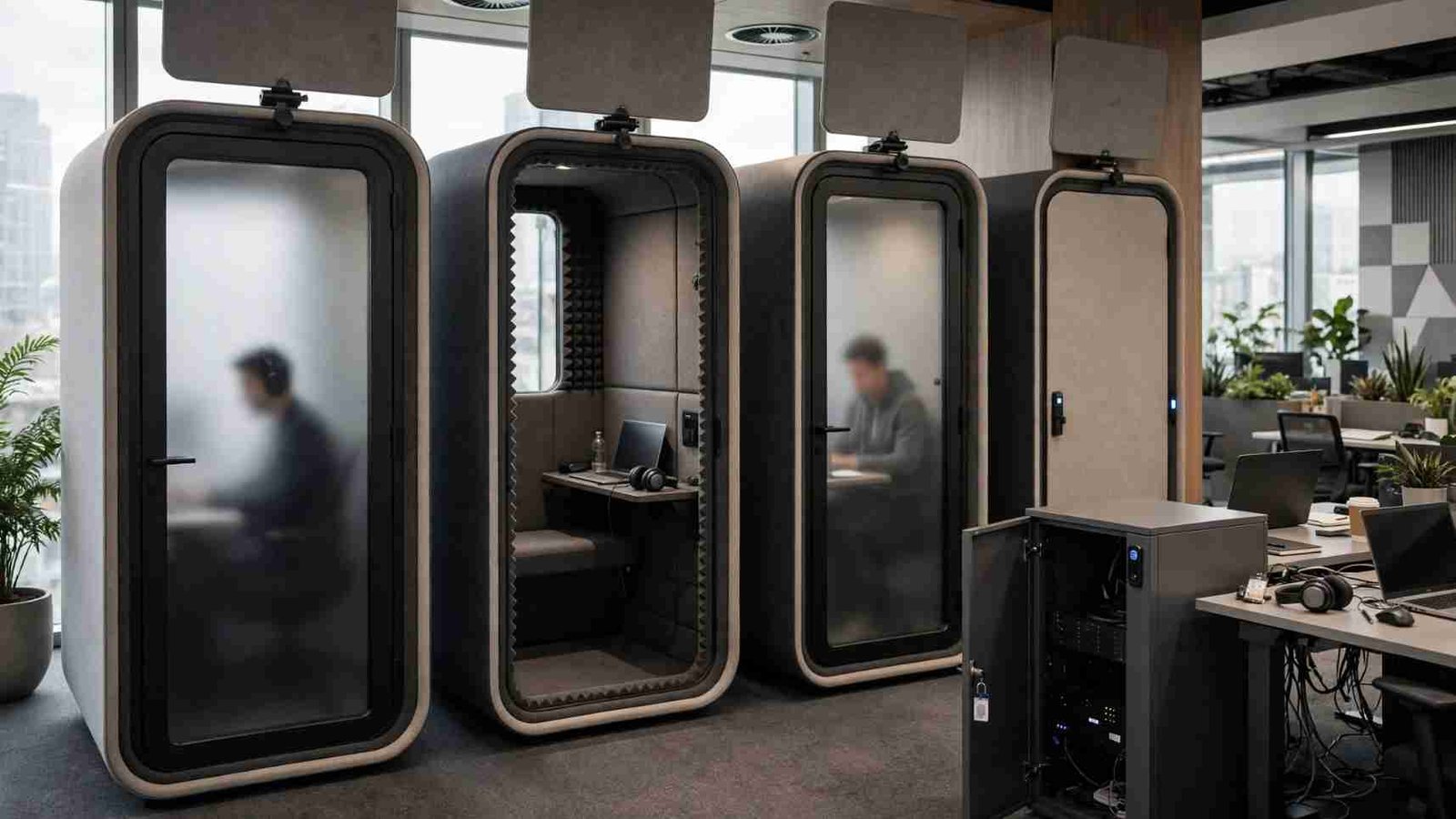
The quick answer: Private offices protect sensitive intellectual property, client confidentiality, and deep focus, whereas coworking spaces introduce constant acoustic distractions and shared digital networks.
While shared lounges look energetic in photos, open-plan arrangements can levy a steep tax on hybrid workplace productivity. Glass-walled coworking suites frequently suffer from poor acoustics, forcing employees to hunt for phone booths whenever confidential client calls or HR discussions arise.
For businesses handling proprietary software code, medical records, or sensitive financial data, shared network infrastructure presents compliance risks. A dedicated private office provides acoustic and digital security. Your team can speak candidly, brainstorm on permanent whiteboards without erasing plans each evening, and install secure network hardware without worrying about adjacent neighbors.
Maintaining productivity in any work environment also depends on managing workloads and ensuring employees have enough time to recover between demanding tasks.
When long hours become unavoidable, clear expectations, appropriate breaks, and supportive management can help reduce stress and prevent exhaustion. Explore these practical strategies for handling mandatory overtime without burnout to support employee well-being and sustainable performance.
Customization and Ergonomics: Designing for Peak Performance
The quick answer: Private offices allow companies to tailor furniture, ergonomics, and aesthetic layouts to their exact operational workflows, directly boosting employee stamina and reducing burnout.
Coworking providers furnish spaces with standardized, one-size-fits-all furniture chosen for aesthetic appeal rather than all-day ergonomic support. When teams spend forty hours a week at basic laminate tables with minimal lumbar support, physical fatigue and posture complaints rise.
A private lease allows you to design an environment built around team ergonomics and daily workflows. Rather than settling for generic furniture, you can configure sit-stand workstations, acoustic booths, and tailored collaboration zones.
Creating a comfortable office environment is only one part of supporting employee well-being. Establishing healthy boundaries around work communication is equally important, particularly for teams working in demanding or always-connected roles. These tips on how to stop checking work email at night offer practical ways to disconnect after work and protect personal time.
For businesses setting up commercial operations in the Southwest, selecting a commercial-grade office desk in Las Vegas ensures active teams benefit from durable, height-adjustable surfaces and supportive seating. Investing in intentional physical infrastructure pays tangible dividends through better focus, fewer physical complaints, and higher employee retention.
The Cost per Desk Tipping Point: When Does Private Space Win?
The quick answer: Coworking delivers superior ROI for teams of 1 to 7 people, while private leased offices become significantly more cost-effective once a company expands beyond 8 to 12 dedicated desks.
To evaluate ROI, conduct a direct flexible workspace cost comparison. In most markets, a dedicated private suite within a coworking hub costs $600 to $1,000 per desk monthly. For a solo professional or a team of four, paying $2,400 to $4,000 per month for a fully serviced space is far cheaper than leasing commercial property.
However, the math flips as your team expands:
- 8 Employees: Coworking runs $4,800 to 8,000monthly(57,600 to $96,000 annually).
- 15 Employees: Coworking reaches $9,000 to 15,000monthly(108,000 to $180,000 annually).
At this scale, leasing 2,000 square feet of commercial space at $25 to $35 per square foot costs $50,000 to $70,000 in base annual rent. Even after adding utilities, janitorial services, and amortized furniture investments, a private office becomes significantly cheaper per employee while providing complete control over your space.
The choice between a coworking space and a private office is a strategic financial decision tied directly to your business lifecycle. Coworking provides unmatched value for early-stage teams, remote hubs, and fluctuating headcounts by eliminating upfront capital expenditures and multi-year lease risks. However, once headcount stabilizes and cross-functional privacy becomes essential, compounding per-desk fees make a dedicated private lease the clear financial winner. Calculating your true cost per desk ensures you invest in a workspace that actively supports productivity, culture, and long-term profitability.