

A business can generate $20,000 in monthly sales and still leave its owner struggling to pay personal bills. The problem often isn’t revenue. It’s the order in which money gets spent.
The profit first method for small business step by step offers a different approach: reserve profit before allowing expenses to consume your income.
Developed by entrepreneur and author Mike Michalowicz, the system uses separate bank accounts, predetermined percentages, and regular transfers to make profitability intentional.
For small business owners, freelancers, and entrepreneurs, it creates a practical framework for controlling expenses, building reserves, and paying themselves consistently.
What Is the Profit First Method, and Why Does It Work?
Traditional accounting calculates profit after subtracting expenses from revenue:
Revenue − Expenses = Profit
Profit First changes the cash-management sequence:
Revenue − Profit = Money Available for Other Purposes
The principle is straightforward. Set aside a portion of incoming revenue before deciding how much the business can afford to spend.
This doesn’t change accounting rules or automatically create economic profit. Instead, it introduces financial boundaries that discourage unnecessary spending.
The Small Business Administration emphasizes maintaining accurate bookkeeping, tracking liabilities, and understanding cash flow. Profit First complements these fundamentals by turning financial intentions into regular habits.
How to Implement the Profit First Method in 7 Steps
Step 1: Examine Where Your Business Money Goes
Before changing your finances, review the previous three months of revenue, operating costs, taxes, and personal withdrawals.
Calculate how much remains after covering every obligation. This establishes your current financial position.
Identify recurring subscriptions, unnecessary purchases, excessive overhead, and inconsistent owner compensation.
A business collecting $12,000 monthly but spending $11,800 has almost no financial flexibility. Understanding that gap is essential before setting ambitious savings targets.
To understand how quickly available cash is being depleted, business owners should also learn how to calculate business burn rate, particularly when expenses are approaching or exceeding monthly revenue.
Step 2: Create Five Dedicated Business Bank Accounts

Separating money by purpose makes spending limits visible.
The standard Profit First system uses five accounts:
- Income: Receives customer payments before distribution.
- Profit: Accumulates money reserved for business profit.
- Owner’s Compensation: Funds payments to the business owner.
- Tax: Reserves money for applicable tax obligations.
- Operating Expenses: Covers business expenses, including rent, software, contractors, and eligible payroll costs.
Choose a financial institution offering convenient transfers, low fees, and appropriate account features.
The Federal Deposit Insurance Corporation explains that eligible deposits are generally insured up to $250,000 per depositor, per insured bank, per ownership category.
Opening several accounts at one bank does not automatically increase insurance protection.
Step 3: Calculate Current and Target Allocation Percentages
Profit First distinguishes between two measurements.
Current Allocation Percentages (CAPs) describe how your business presently distributes money.
Target Allocation Percentages (TAPs) represent your intended financial structure.
For example, a small service business might initially aim for:
| Allocation | Target | On $10,000 |
| Profit | 5% | $500 |
| Owner’s compensation | 50% | $5,000 |
| Taxes | 15% | $1,500 |
| Operating expenses | 30% | $3,000 |
| Total | 100% | $10,000 |
These figures are illustrative, not universal requirements.
A retailer purchasing substantial inventory may need a different operating-expense allocation than a freelance consultant.
Calculate allocations using an appropriate revenue base. Businesses with significant materials or subcontractor costs may first separate those costs and allocate the remaining amount.
Step 4: Begin With a Small Profit Percentage
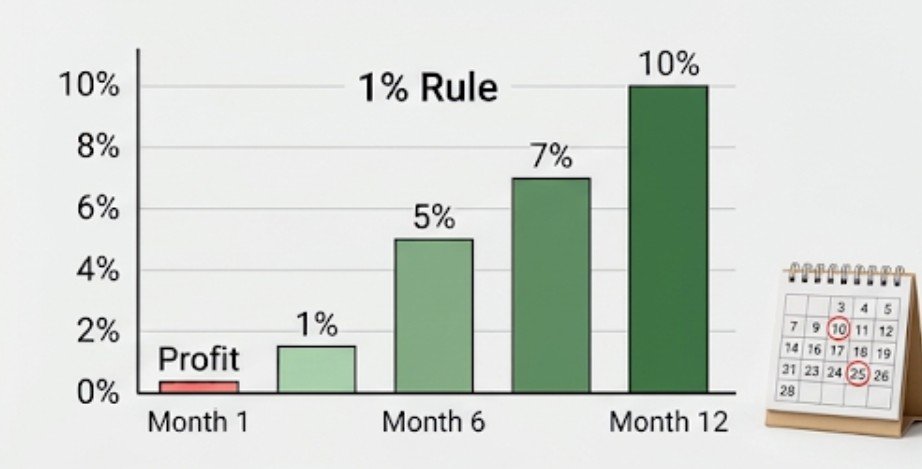
Attempting to reserve 10% of revenue immediately can create serious cash shortages.
Instead, begin with 1% if your financial situation permits.
For every $5,000 collected, transfer $50 into the Profit account.
Although the amount appears modest, it establishes a repeatable financial habit.
Review your position monthly or quarterly. Increase the percentage gradually when operating cash flow supports the adjustment.
Avoid raising allocations while neglecting overdue bills, payroll obligations, or essential inventory purchases.
Step 5: Schedule Transfers Twice Monthly
The traditional Profit First schedule recommends allocating income on the 10th and 25th of each month.
On each allocation date, move accumulated funds from Income into the designated accounts according to your chosen percentages.
Pay ordinary business expenses from the Operating Expenses account and owner compensation from its designated account.
This process limits spontaneous spending.
However, businesses with frequent payroll obligations or irregular customer payments may require more frequent transfers.
The important factor is consistency, not rigid adherence to particular calendar dates.
Step 6: Review Profit Every Quarter
Every quarter, examine the amount accumulated in your Profit account.
A common Profit First practice involves distributing 50% of the eligible accumulated profit to the owner and retaining the remainder as a reserve.
For example, if the account contains $3,000 available for distribution, the owner might receive $1,500 while retaining $1,500.
Before withdrawing anything, confirm that the business can meet upcoming obligations.
Tax treatment also matters. Depending on the business structure, owner payments may be classified differently, and a distribution is not necessarily a deductible business expense.
Step 7: Adjust Expenses Instead of Raiding Reserves
If operating expenses consistently exceed their allocation, investigate the underlying problem.
Review vendor agreements, subscription costs, staffing efficiency, pricing, and profit margins.
A struggling business may need to renegotiate contracts, eliminate low-value services, or increase prices.
Avoid routinely transferring reserved tax money into operating accounts.
The goal is to make the business sustainable within its financial capacity rather than repeatedly hiding overspending.
How Should Small Businesses Handle Taxes Under Profit First?
Tax allocations deserve special attention because a fixed percentage cannot accurately represent every business owner’s liability.
Federal income taxes, self-employment taxes, state taxes, and entity-specific obligations may affect the required amount.
According to the Internal Revenue Service’s estimated tax guidance, eligible taxpayers generally make estimated payments across four payment periods.
Consult a qualified tax professional to establish an appropriate reserve percentage and payment schedule.
Remember that moving money into a tax account does not constitute paying the IRS. The funds must actually reach the appropriate tax authority by the applicable deadline.
Common Profit First Mistakes That Can Hurt Cash Flow

Confusing Allocated Cash With Accounting Profit
A dedicated Profit account doesn’t replace financial statements. According to IRS Publication 334, business profit or loss depends on income and allowable expenses under applicable accounting and tax rules. Continue maintaining accurate bookkeeping and reconciling accounts.
Ignoring Seasonal Revenue Changes
Retail businesses, landscaping companies, and seasonal service providers often experience uneven income.
During these slower periods, understanding how to handle quiet seasons in business can help owners manage reduced income, protect cash reserves, and maintain essential operations without disrupting their financial plans.
A profitable month doesn’t guarantee sufficient cash for the following quarter.
SCORE’s cash flow management resources recommend forecasting incoming and outgoing cash to identify future shortages.
Maintain a rolling 13-week cash forecast alongside Profit First allocations.
Using Generic Percentages Without Testing Them
Different businesses operate with different labor costs, margins, debt payments, and capital requirements.
Test your allocations against actual obligations before committing to them.
Companies experiencing losses, significant debt pressure, or immediate liquidity problems may need financial restructuring before increasing profit distributions.
Frequently Asked Questions
1. Can a new business use the Profit First method?
Yes. New businesses can begin with modest allocations and separate accounts. However, startups should prioritize essential expenses, working capital, and financial stability before increasing profit withdrawals.
2. How much should small businesses allocate to profit?
Starting with 1% can be manageable for some businesses. The appropriate long-term percentage depends on revenue, operating margins, debt obligations, and available cash reserves.
3. Does Profit First replace bookkeeping software?
No. Profit First manages how cash is distributed. Bookkeeping software records financial transactions, tracks business performance, and supports accurate financial reporting.
4. What happens if operating expenses exceed the budget?
Review costs, pricing, and upcoming obligations immediately. Adjust spending or allocations realistically rather than repeatedly using tax reserves to cover ordinary expenses.
Make Profit a Financial Habit
A business shouldn’t need record-breaking sales to begin developing healthier financial habits.
The profit first method for small business step by step creates a practical starting point by making every dollar serve a defined purpose.
However, sustainable profitability requires more than transferring money between accounts. Accurate financial records, responsible pricing, realistic tax planning, and disciplined expense management remain essential.
For business owners looking beyond day-to-day financial management, developing a business exit strategy for solopreneurs can help connect consistent profitability with long-term business value and reduced founder dependence.
Begin by reviewing recent transactions, establishing separate accounts, and choosing an affordable initial profit allocation.
Over time, small improvements can create meaningful financial breathing room.
The most valuable change isn’t simply saving more money. It’s building a business that makes deliberate financial decisions before the money disappears.