

Every client project you complete could contain the foundation for a product you can sell hundreds of times. The challenge is recognizing which parts of your expertise customers will actually pay for without personalized assistance.
Understanding how to transition from client work to digital products starts with an important distinction: selling knowledge is not the same as selling your time. Templates, online courses, downloadable resources, and automated tools can generate revenue beyond individual client appointments.
However, building a sustainable product business requires customer research, financial planning, and a gradual change in how you deliver value.
Find a Digital Product Hidden in Your Existing Work
Your first product idea probably already exists somewhere in your client workflow.
Instead of brainstorming completely new business concepts, examine the tools, documents, and processes that consistently help your customers achieve results.
Identify Problems You Solve Repeatedly
Review your last ten client projects and document recurring requests.
Look for opportunities involving:
- Templates that simplify repetitive tasks.
- Checklists that prevent expensive mistakes.
- Spreadsheets that organize complicated information.
- Instructional guides explaining specialized processes.
- Reusable workflows that improve productivity.
For example, a freelance bookkeeper might transform a general financial tracking system into a downloadable budgeting spreadsheet for independent contractors.
The important requirement is that customers can use the product successfully without extensive individual guidance.
Choose the Right Product Format
Different products serve different customer needs.
Templates work well when buyers want to complete tasks faster. Guides are useful when customers need straightforward instructions.
Video courses suit complicated subjects requiring demonstrations, while Notion dashboards and spreadsheet systems help users manage ongoing activities.
A fixed-price, standardized service can also bridge the gap between customized consulting and fully self-service products.
Begin with the simplest format that produces a meaningful result.
Validate Demand Before Spending Months Creating Something

Having expertise does not guarantee that people want to purchase your product.
The Small Business Administration’s business planning guidance emphasizes examining competitors, market segments, and opportunities before investing resources.
Similarly, SCORE’s market research resources recommend investigating whether customers have a genuine willingness to pay.
Run a Small Product Validation Test
Before building your complete product, follow this process:
- Identify one specific customer problem.
- Interview five to ten potential buyers.
- Ask what solutions they currently use.
- Create a simple product description or sample.
- Offer a discounted early-access version.
- Track purchases and requests for improvements.
For example, suppose ten prospective customers express interest in a $49 project management template, but nobody purchases it.
That difference between enthusiasm and actual spending matters.
You may need to adjust the product, target audience, pricing, or sales message before investing additional time.
Real purchases provide stronger evidence than social media likes or encouraging comments.
Build a Financial Safety Net Before Reducing Client Work
One of the biggest mistakes freelancers make is abandoning reliable contracts immediately after launching a digital product.
Before reducing recurring client commitments, freelancers should establish clear payment schedules, service expectations, and renewal conditions through client retainer agreement best practices that help protect predictable income while their digital product revenue develops.
Product revenue can fluctuate considerably, especially before an established marketing system develops.
Preparing for fluctuations in product sales is just as important as planning the transition itself, and understanding how to handle quiet seasons in business can help freelancers manage cash flow, retain customers, and maintain financial stability during slower periods.
Calculate Your Minimum Monthly Revenue
Start by identifying the income your business needs to remain financially stable.
Consider this hypothetical situation:
- Monthly business and living expenses: $4,000
- Existing monthly client revenue: $5,500
- New digital product price: $50
- Planned reduction in client income: $1,500
Replacing $1,500 requires 30 product sales monthly before transaction fees, refunds, taxes, and additional expenses.
If each sale contributes only $40 after variable costs, approximately 38 sales would be necessary.
This calculation exposes whether your expected sales volume is realistic.
Maintain a cash reserve appropriate to your circumstances and consider reducing client commitments only after product profits become reasonably consistent.
For additional financial flexibility, explore flexible side income opportunities for full-time workers while developing your product business.
Follow a Realistic 12-Month Transition Roadmap
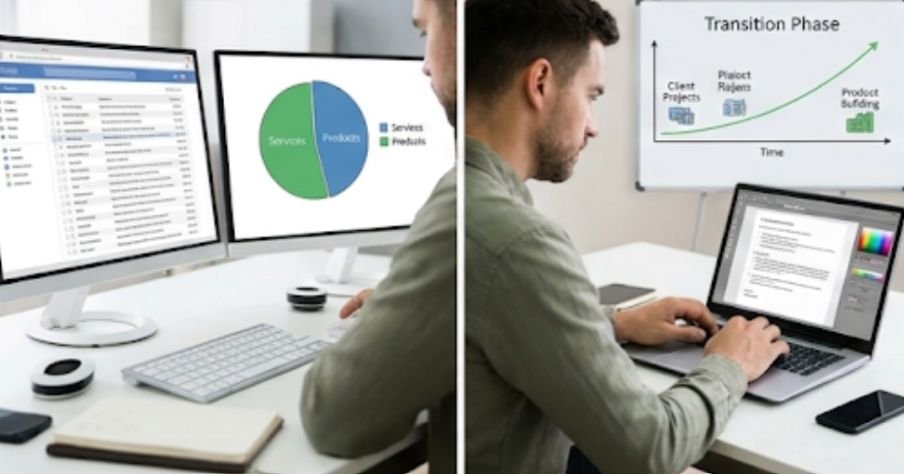
A gradual transition gives you time to test demand without putting existing income at unnecessary risk.
Months 1–3: Develop Your First Product
Audit completed projects, identify recurring customer challenges, and select one promising digital offering.
Create a minimum viable product rather than an elaborate course or extensive resource library.
Use Canva for visual templates, Google Docs for instructional materials, or Notion for reusable organizational systems.
Concentrate on usability and customer results instead of expensive production.
Months 3–6: Launch and Improve
Introduce your product to a small audience through email subscribers, professional contacts, or relevant communities.
Consider using Payhip or Beacons to manage storefront functions, depending on current pricing and features.
Collect feedback about confusing instructions, missing features, and purchasing obstacles.
Improve the product before expanding promotional spending.
Months 6–12: Expand Without Overextending
Once your first product demonstrates repeatable demand, consider complementary resources.
A website designer selling landing-page templates might introduce conversion checklists or website maintenance planners.
Gradually prioritize profitable client projects while reserving scheduled hours for product development and marketing.
By the second year, some businesses may become primarily product-driven. Others will benefit from retaining a balanced combination of services and products.
The transition should follow financial evidence, not an arbitrary deadline.
Create a Simple Digital Sales System
A well-designed product still needs an efficient way to reach potential customers. Build a straightforward sales system using a few essential components.
Product Delivery and Customer Experience
Create a clear sales page explaining the intended customer, product contents, expected benefits, and limitations.
Include screenshots, usage instructions, compatible software requirements, and refund terms.
Automated checkout and download delivery reduce administrative work, but test the complete buying process before launching publicly.
Email Marketing and Audience Growth
Offer a genuinely useful free resource, such as a short checklist, worksheet, or sample template.
Use an email marketing platform, such as Omnisend, to deliver resources and introduce relevant paid products.
Follow the Federal Trade Commission’s CAN-SPAM guidance, which explains requirements for commercial emails, including accurate sender information and unsubscribe options.
Content marketing, search optimization, professional communities, and customer referrals can also attract qualified buyers.
Protect Your Products and Stay Financially Compliant
Turning professional experience into sellable products creates legal responsibilities.
Before reusing materials developed for clients, review confidentiality provisions, licensing agreements, and intellectual property ownership.
The U.S. Copyright Office explains that ownership can depend on employment arrangements, work-for-hire rules, and contractual transfers.
Create original resources rather than repackaging confidential client documents.
Digital product earnings also require appropriate tax reporting. The Internal Revenue Service explains that self-employed individuals may need to make estimated tax payments.
State and local sales tax obligations can vary by product type and customer location, making professional tax guidance valuable.
Know When Digital Products Are Not the Better Business Mode
Not every service translates effectively into a downloadable product.
Highly specialized consulting, confidential advisory work, and projects requiring constant customization may produce stronger returns through direct client relationships.
Products also become less attractive when customer acquisition costs exceed expected profits.
Evaluating whether a digital product remains financially sustainable also requires understanding its ongoing cash requirements, and knowing how to calculate business burn rate helps freelancers assess operating costs, track cash consumption, and determine whether their product revenue can support long-term growth.
Evaluate revenue per hour invested, customer support requirements, refunds, and repeat purchases before expanding.
Digital products should improve your business economics rather than simply create another demanding workload.
Frequently Asked Questions
1. How long does it take to transition from client work to digital products?
Many freelancers can develop and test an initial product within three to six months. Replacing substantial client income may take considerably longer, depending on demand and marketing effectiveness.
2. Can beginners sell digital products without a large audience?
Yes. Beginners can attract customers through search traffic, professional networks, niche communities, and partnerships. A clearly defined audience often matters more than follower count.
3. What digital products are easiest to create?
Checklists, downloadable guides, spreadsheets, and customizable templates are generally easier to develop than extensive courses or software products.
4. Should freelancers stop accepting clients after launching products?
Not necessarily. Maintaining selected clients can provide financial stability, industry insights, and valuable feedback while product sales develop.
Build Freedom Through Proven Demand
Learning how to transition from client work to digital products is ultimately about creating a business that does not depend entirely on constant client delivery.
The smartest transition begins with one recurring customer problem, one practical solution, and a carefully measured launch.
Continue serving profitable clients while testing whether buyers genuinely value your digital resources. Monitor expenses, improve customer experiences, and expand only when financial results support the decision.
Most importantly, remember that scalability comes from solving problems repeatedly, not simply producing more downloadable files.
Your existing expertise has already created value for clients. The next opportunity is making that value accessible to a wider audience.