
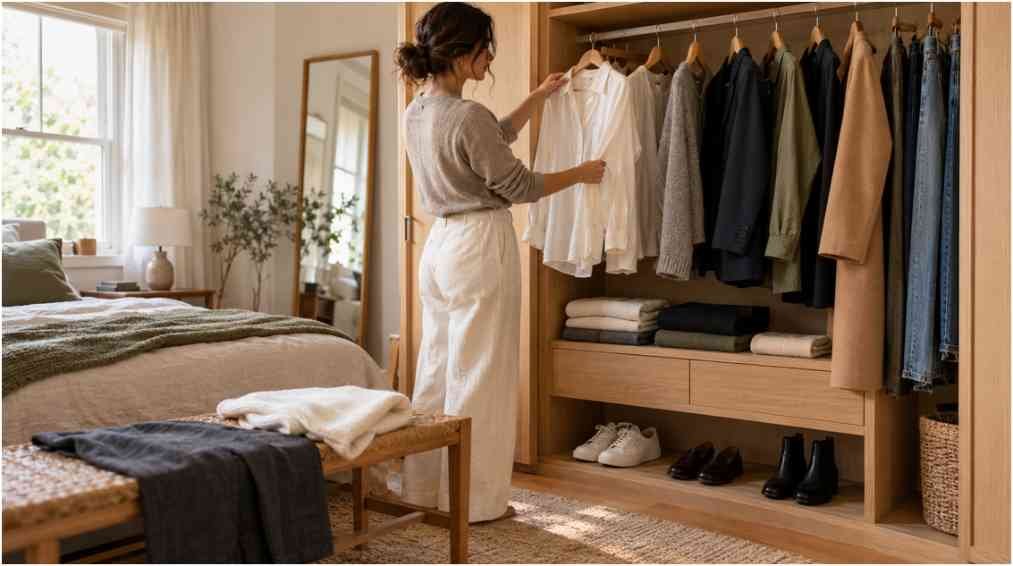
Two years ago, my closet held over 140 garments, yet I wore the exact same four outfits every single week. Getting dressed each morning triggered sudden decision fatigue, leaving clean clothes strewn across the bed while I ran late for work.
I decided to stop chasing seasonal clearance racks and rebuilt my relationship with clothing from scratch. Curating a capsule wardrobe intentional choices framework transformed my mornings from chaotic guessing games into a smooth, 90-second routine.
When you strip away visual clutter and keep only pieces that fit your actual daily life, you uncover personal style clarity you never knew existed.
The Reality of Decision Fatigue and Clothing Clutter
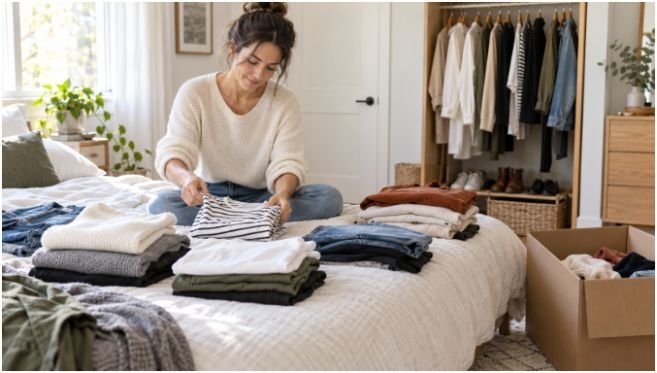
Every item hanging in your closet demands cognitive energy. When you open a wardrobe packed with ill-fitting trousers and impulse buys, your brain evaluates dozens of impossible combinations before your day even starts.
The environmental toll of this accumulation is staggering. According to the United States Environmental Protection Agency, Americans generate over 17 million tons of municipal solid textile waste annually, with the vast majority landing directly in landfills or combustion facilities. Constant churning of cheap apparel degrades both our mental space and natural ecosystems.
Escaping the Aspirational Purchase Trap
My worst wardrobe mistakes happened when I bought clothes for an imaginary persona. I bought silk blouses that required delicate hand-washing, stilettos that blistered my feet within twenty minutes, and dry-clean-only blazers that languished under plastic wraps.
Real life demanded durable, breathable clothes suitable for long desk hours, brisk walks, and impromptu grocery runs. Acknowledging who I am Monday through Sunday—rather than who I might be at an imaginary gala—broke my consumption loop. Transitioning to a low consumption lifestyle started right on those closet rails.
Core Architectural Rules for Intentional Clothing Selection
Intentional dressing requires strict structural boundaries. Without rules, a capsule collapses back into a disorganized mess within two months. I rely on three non-negotiable guidelines to evaluate every candidate garment.
The 3-to-1 Coordination Ratio
Bottoms anchor the silhouette, while tops set formality and seasonal adaptability. For every pair of pants, skirts, or shorts in my rotation, I require at least three tops that pair seamlessly without awkward adjustments.
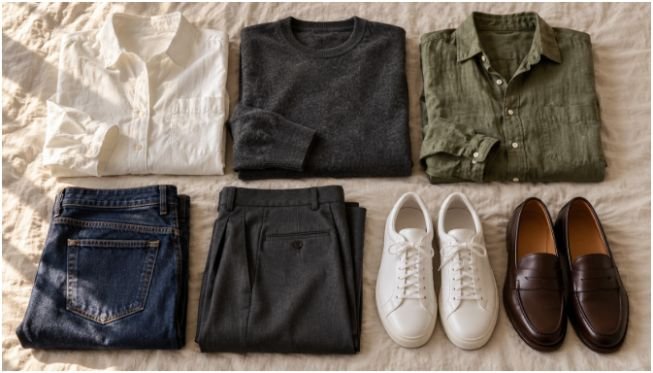
If a dark charcoal wool trouser pairs effortlessly with my white poplin shirt, a grey crewneck sweater, and an olive ribbed tee, it earns its hanger. If a printed skirt matches only one specific blouse, it exits the primary closet.
Fabric Durability and Natural Fibers Over Polyester
Synthetic fast fashion relies heavily on virgin polyester and nylon, petroleum-based textiles that pill quickly and trap body odors after minimal wear. Research published by the Ellen MacArthur Foundation underscores that textile production consumes immense non-renewable resources while contributing massive microplastic shedding during domestic wash cycles.
I prioritize natural, long-staple fibers:
- Heavyweight Pima and Giza Cotton: Retains structural shape across fifty-plus wash cycles without seam twisting.
- Medium-Weight French Linen: Softens with age, wicks moisture during humid summer days, and layers easily under knitwear.
- Merino Wool: Resists wrinkles naturally, regulates core body temperature, and requires airing out rather than frequent machine washing.
Fabric testing reports from Cotton Incorporated’s Lifestyle Monitor repeatedly show that garments constructed from quality natural fibers exhibit significantly longer physical wear cycles, validating their upfront investment.
The 5-Phase Closet Diagnostic and Audit
You cannot organize excess; you must remove it. I execute a systematic audit every six months to calibrate my wardrobe against reality.
The Four-Pile Sort and the 60-Day Quarantine Box
Clear your bed and empty your wardrobe entirely. Touch every garment once and place it into one of four piles:
- Active Core: Items worn within the last four months that fit comfortably right now.
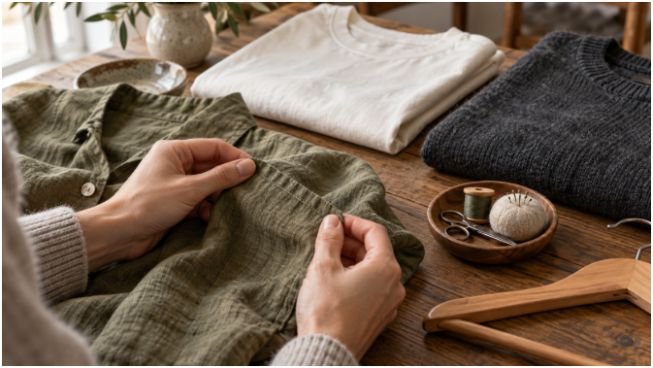
- Alterations: Quality garments needing simple tailoring, like a shortened hem or replaced button. If uncompleted within fourteen days, donate them.
- Outright Relinquishment: Worn-out, stained, uncomfortable, or ill-fitting pieces sent directly to textile recycling or thrift centers.
- The Quarantine Box: Items carrying emotional baggage or “what if” anxieties.
Pack the quarantine items into a sealed cardboard box, slide it under a bed or into a storage closet, and set a reminder on your phone for sixty days. If you do not open the container to retrieve an item during that period, donate it without opening the lid. This psychological buffer eliminates decluttering regret and mirrors the practical strategies used when downsizing home for simple living.
Tracking Actual Wear with the Reverse Hanger Method
Human memory miscalculates clothing frequency. We convince ourselves that we wear specialty clothes far more than we do.
To collect real data, hang all garments with hanger hooks facing backward—pointed toward you. After washing and drying a worn piece, return it to the rail with the hook facing forward. After ninety days, every backward hanger reveals an underutilized garment. The results are eye-opening.
Curating the Core Rotation: A Practical 18-Piece Foundation
This modular 18-piece wardrobe yields dozens of distinct configurations without feeling repetitive. It relies on a neutral base palette of black, charcoal, navy, and ivory, accented with subtle olive and terracotta tones.
| Category | Item Description | Primary Function | Pairing Compatibility |
| Tops (6) | 2 Heavyweight Pima cotton tees (white, black) | Casual baseline, base layer | Pairs with all 5 bottoms |
| 1 Crisp cotton poplin button-down (ivory) | Professional anchor, light summer overshirt | Pairs with all 5 bottoms | |
| 1 Silk-cotton knit polo (navy) | Smart-casual bridge piece | Denim, trousers, slip skirt | |
| 1 Fine-gauge merino crewneck (charcoal) | Cold-weather layering, office warmth | Denim, trousers, chinos | |
| 1 Relaxed linen workshirt (olive) | Breathable daytime casual layer | Chinos, denim, utility shorts | |
| Bottoms (5) | 1 Straight-leg raw selvedge denim (indigo) | Rugged weekend and casual work staple | Pairs with all 6 tops |
| 1 Tailored wool-blend trousers (charcoal) | Formal foundation, elevated dinner wear | Poplin shirt, merino, polo, tee | |
| 1 Relaxed pleated chinos (khaki) | Casual weekday anchor | All 6 tops | |
| 1 Bias-cut satin midi skirt (black) | Evening and warm-weather alternative | Tees, knit polo, merino | |
| 1 Structured linen-blend short (tobacco) | High-heat summer staple | Tees, poplin shirt, linen shirt | |
| Layers (3) | 1 Unstructured wool-blend blazer (navy) | Formalizes any combination instantly | Denim, trousers, chinos |
| 1 Chore coat in heavy cotton canvas (camel) | Utilitarian outer layer for mild weather | All bottoms | |
| 1 Lightweight trench coat (stone grey) | Inclement weather protection and drape | All tops and bottoms | |
| Footwear (4) | 1 Minimalist leather sneaker (white) | High-mileage everyday walking | Denim, chinos, shorts |
| 1 Blake-stitched leather loafer (espresso) | Office, meetings, elevated dinners | Trousers, denim, skirt | |
| 1 Weatherproof Chelsea boot (black) | Rain, winter commute, rougher conditions | Denim, trousers, chinos | |
| 1 Leather slide sandal (tan) | Warm-weather casual wear | Skirt, shorts, chinos |
The Wear-Cost-Friction Matrix: Measuring Real-World Utility
To prevent buyer’s remorse, evaluate new purchases through this diagnostic calculation before checking out:
PracticalValue=RetailCost+MaintenanceBurdenAnticipatedMonthlyWearsComfortIndex
- Retail Cost: Purchase price in dollars.
- Maintenance Burden: Estimated annual dry cleaning or specialized care expenses.
- Anticipated Monthly Wears: Conservative estimate based on historical habits (capped at 8).
- Comfort Index: A score from 1 (restricting, scratchy) to 5 (breathable, uninhibited motion).
A $180 raw denim jean worn 12 times a month with a comfort rating of 4 yields a high practical value score. A $60 synthetic blouse that scratches your skin and requires dry cleaning scores abysmally low despite the cheaper price tag. Let math protect your closet from cheap, high-friction items.
Frequently Asked Questions About Intentional Wardrobes
1. How many clothes should a beginner capsule wardrobe contain?
Most people succeed starting with 25 to 35 seasonal items, excluding workout clothes, sleepwear, and underwear.
2. Can I build an intentional wardrobe using colorful pieces?
Yes; choose two harmonizing base neutrals like cream and navy, then limit accents to two coordinating colors like rust and forest green.
3. How often do I need to rotate or replace capsule wardrobe items?
Reassess your rotation twice a year between warm and cold seasons, replacing garments only when they suffer unrepairable wear.
4. Does building a functional wardrobe require expensive designer brands?
No; prioritize construction details like tight seams, natural fiber content, and proper fit over luxury brand labels.
Wear What Serves You, Ditch the Rest
An intentional wardrobe is not an exercise in ascetic deprivation, nor does it require dressing like a minimalist monk. It is an intentional boundary that keeps clutter out of your morning routine and preserves your mental energy for things that actually matter.
Take thirty minutes this evening to turn your closet hangers around. Watch the data accumulate over the coming weeks, let go of the garments you avoid, and build a wardrobe that works as hard as you do.