
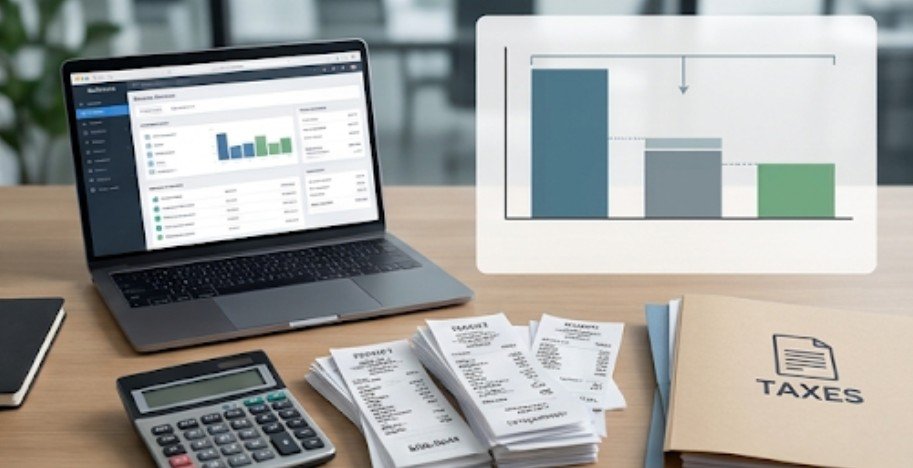
A business can generate six figures in annual sales and still leave its owner struggling to cover personal expenses. Revenue looks impressive on paper, but the money remaining after operating costs, taxes, and reinvestment determines whether the business actually supports your lifestyle.
Understanding how to set business revenue targets based on desired income changes that equation. Instead of choosing an ambitious sales number, you calculate what your business must earn to provide the take-home pay you want.
The process starts with your personal financial needs and works backward through business expenses, taxes, profit reserves, and realistic sales expectations.
Start With the Income You Actually Want to Keep
Your first calculation should happen outside the business.
Determine how much money you need each month for housing, groceries, transportation, health insurance, debt payments, retirement contributions, and personal savings.
The Consumer Financial Protection Bureau’s budgeting guidance recommends reviewing several months of spending to capture irregular expenses that monthly estimates often overlook.
Turn Monthly Living Expenses Into an Annual Goal
Suppose your personal budget requires $4,200 monthly, and you want another $800 for savings and unexpected expenses.
Your desired income becomes:
$4,200 + $800 = $5,000 monthly
$5,000 × 12 = $60,000 annually
That $60,000 represents your desired personal income after taxes, not your business revenue.
This distinction prevents one of the most common financial planning mistakes: treating every dollar received from customers as available personal income.
Calculate What It Costs to Operate Your Business
Once you establish your personal income requirement, calculate annual business expenses.
Include recurring obligations such as software subscriptions, commercial rent, insurance, advertising, bookkeeping, contractor payments, and professional services.
Separate expenses into two categories.
Fixed Expenses
Fixed costs generally remain predictable regardless of monthly sales volume. These include rent, subscription fees, insurance premiums, and certain administrative expenses.
Variable Expenses
Variable costs change with customer demand or production activity. Examples include payment processing, packaging, shipping, materials, and sales commissions.
For illustration, assume your business spends $2,000 monthly on operating expenses.
That creates an annual expense estimate of $24,000.
Review historical records rather than relying entirely on memory. Also distinguish deductible business expenses from loan principal payments and other cash obligations, which may require separate budgeting.
Account for Taxes Before Setting Your Sales Target

Taxes can substantially reduce the amount an entrepreneur retains.
According to the Internal Revenue Service’s self-employment tax guidance, the standard self-employment tax rate is 15.3%, consisting of Social Security and Medicare components, subject to applicable rules and limits.
Federal income taxes and potentially state or local taxes are additional considerations.
For planning purposes, some entrepreneurs use a provisional 25% tax estimate, but that percentage is not universally appropriate.
Actual liabilities depend on taxable profit, deductions, filing status, business structure, and location.
A sole proprietor’s tax treatment differs from that of an S corporation owner receiving wages and distributions.
Consult a qualified tax professional before finalizing your assumptions. A revenue plan built on an inaccurate tax estimate can create serious cash shortages.
Reverse-Engineer Your Revenue Target With a Practical Formula
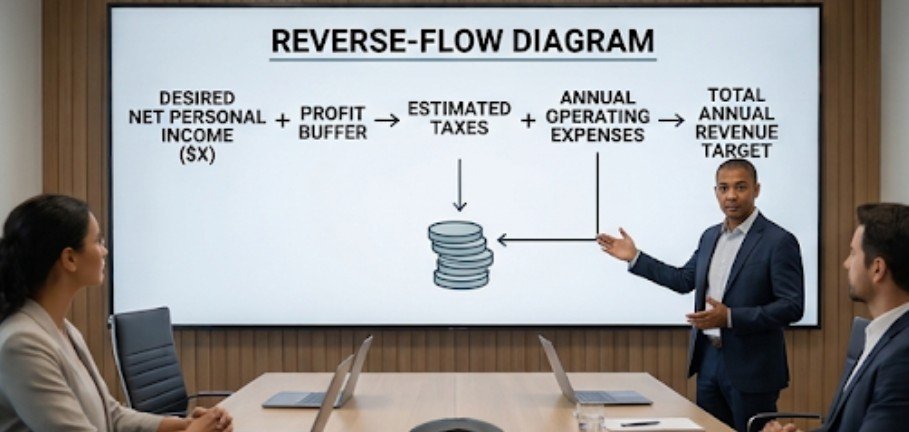
The most useful way to calculate business revenue requirements is to account for the money you want to keep, taxes, operating expenses, and retained business funds.
For a simplified planning model:
Required Revenue = [(Desired Take-Home Pay + After-Tax Business Reserve) ÷ (1 − Estimated Tax Rate)] + Operating Expenses
This model assumes the estimated tax rate applies to business profit before the owner withdraws income or retains reserves, with operating expenses already accounted for.
Example: Building a Business That Pays You $60,000
Consider a self-employed service provider with these annual targets:
- Desired after-tax personal income: $60,000
- After-tax business reserve: $10,000
- Estimated effective tax rate: 25%
- Annual operating expenses: $24,000
First, combine personal income and the reserve:
$60,000 + $10,000 = $70,000
Next, calculate the required pretax business profit:
$70,000 ÷ 0.75 = $93,333
Finally, add operating expenses:
$93,333 + $24,000 = $117,333
ILLUSTRATIVE REVENUE TARGET
$117,333/year
Approximately $9,778 in monthly revenue
How that annual revenue is allocated
Personal take-home pay
$60,000
Operating expenses
$24,000
Estimated taxes
$23,333
Retained business reserve
$10,000
Rounded illustrative amounts; actual tax liability and required revenue will vary.
This approach provides a more useful financial target than simply aiming for six-figure sales.
Use Profit First Principles to Protect Your Earnings
The Profit First approach, developed by Mike Michalowicz, encourages business owners to allocate revenue deliberately rather than treating profit as whatever remains after spending.
For a practical breakdown of implementing this approach, explore the Profit First method for small business step by step to learn how to organize dedicated accounts, establish allocation percentages, and build consistent profit reserves.
Its central principle is straightforward: give profit a defined place in the budget.
Owners can establish separate accounts or accounting categories for operating costs, owner compensation, tax obligations, and retained profits.
A simplified allocation might designate 50% for owner compensation, 30% for expenses, 15% for taxes, and 5% for profit.
These percentages are illustrations, not universal benchmarks. They must be adapted to actual costs and tax obligations.
Importantly, transferring money into a reserve account does not automatically reduce taxable income. Tax obligations follow applicable accounting and tax rules.
Convert Your Revenue Number Into Client and Sales Goals
Understanding how to set business revenue targets based on desired income becomes valuable when the financial goal translates into daily business decisions.
Using the previous example, round your monthly revenue objective to $10,000 to allow a modest cushion.
If an average client pays $2,000, you need five equivalent client purchases each month.
For a service business with a 20% conversion rate from qualified sales conversations, securing five new clients requires approximately 25 conversations.
That means roughly six qualified conversations weekly, assuming four selling weeks.
However, recurring contracts, customer retention, refunds, and project delivery capacity can change these requirements.
For service providers looking to increase revenue without relying entirely on additional client projects, learning how to transition from client work to digital products can open opportunities to create more scalable income streams.
The SCORE sales forecasting resource recommends using historical sales, product categories, and seasonal demand patterns to make revenue projections more realistic.
A practical sales forecast connects desired earnings to evidence of actual customer demand.
Stress-Test Your Target Before Committing

A revenue target should remain useful when conditions change.
As your business grows, developing a business exit strategy for solopreneurs can help you build long-term business value, reduce dependence on personal involvement, and create more financial flexibility for the future.
Test three scenarios: expected sales, sales 20% below expectations, and sales 20% above expectations.
Examine how each scenario affects operating costs, owner compensation, and cash reserves.
The FDIC Money Smart for Small Business program emphasizes cash flow management as an essential business skill.
That matters because profitable sales do not always produce immediate cash. Customers may pay late, seasonal demand may fluctuate, or unexpected equipment expenses may arise.
Review the following questions monthly:
- Are actual sales meeting projected revenue?
- Has the average profit per customer changed?
- Can the business afford the planned owner withdrawals?
- Are reserves sufficient for slower months?
- Does the workload support the required number of sales?
For businesses with high material costs, calculate contribution margin before setting customer-volume targets. Revenue alone can overstate what each additional sale contributes toward owner income.
Frequently Asked Questions
1. How much revenue does a business need to pay its owner $100,000?
It depends on expenses, taxes, and retained profits. For example, $40,000 in operating expenses, a $10,000 after-tax reserve, and a 25% effective tax assumption imply approximately $186,667 in revenue.
2. Should revenue goals be calculated monthly or annually?
Use both. Annual targets establish financial direction, while monthly targets help manage sales activity, seasonal fluctuations, operating expenses, and available cash.
3. What is a reasonable profit margin for a small business?
There is no universal percentage. Profitability varies by industry, pricing strategy, overhead, and business model. Compare your margins with relevant industry benchmarks and historical performance.
4. How often should business revenue targets be updated?
Review progress monthly and reassess assumptions quarterly. Major changes in pricing, expenses, taxes, customer demand, or personal income requirements may justify earlier adjustments.
Make Revenue Serve a Purpose
A revenue milestone matters only if it produces the financial outcome you intended.
Learning how to set business revenue targets based on desired income helps replace arbitrary growth expectations with measurable financial decisions. Every sales target should connect to personal compensation, operating requirements, tax responsibilities, and long-term business stability.
Start with your actual household budget, calculate the cost of supporting it, and determine whether your sales capacity can realistically deliver the required revenue.
Revisit those calculations as your business evolves. The strongest financial target is not necessarily the largest number on a sales report. It is the amount that consistently supports your life while keeping your business financially healthy.